


Page 49 - Demo
P. 49
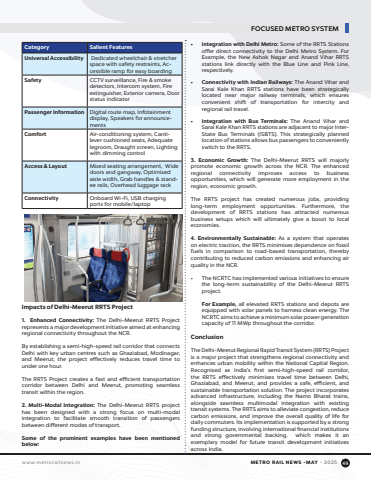
www.metrorailnews.in METRO RAIL NEWS -MAY - 2025 49CategorySalient FeaturesUniversal Accessibility Dedicated wheelchair & stretcher space with safety restraints, Accessible ramp for easy boardingSafetyCCTV surveillance, Fire & smoke detectors, Intercom system, Fire extinguisher, Exterior camera, Door status indicatorPassenger InformationDigital route map, Infotainment display, Speakers for announcementsComfortAir-conditioning system, Cantilever cushioned seats, Adequate legroom, Draught screen, Lighting with dimming controlAccess & LayoutMixed seating arrangement, Wide doors and gangway, Optimised aisle width, Grab handles & standee rails, Overhead luggage rackConnectivityOnboard Wi-Fi, USB charging ports for mobile/laptopImpacts of Delhi-Meerut RRTS Project 1. Enhanced Connectivity: The Delhi-Meerut RRTS Project represents a major development initiative aimed at enhancing regional connectivity throughout the NCR.By establishing a semi-high-speed rail corridor that connects Delhi with key urban centres such as Ghaziabad, Modinagar, and Meerut, the project effectively reduces travel time to under one hour. The RRTS Project creates a fast and efficient transportation corridor between Delhi and Meerut, promoting seamless transit within the region.2. Multi-Modal Integration: The Delhi-Meerut RRTS project has been designed with a strong focus on multi-modal integration to facilitate smooth transition of passengers between different modes of transport.Some of the prominent examples have been mentioned belo %u2022Integration with Delhi Metro: Some of the RRTS Stations offer direct connectivity to the Delhi Metro System. For Example, the New Ashok Nagar and Anand Vihar RRTS stations link directly with the Blue Line and Pink Line, respectively. %u2022Connectivity with Indian Railways: The Anand Vihar and Sarai Kale Khan RRTS stations have been strategically located near major railway terminals, which ensures convenient shift of transportation for intercity and regional rail travel.%u2022Integration with Bus Terminals: The Anand Vihar and Sarai Kale Khan RRTS stations are adjacent to major InterState Bus Terminals (ISBTS). This strategically planned location of stations allows bus passengers to conveniently switch to the RRTS. 3. Economic Growth: The Delhi-Meerut RRTS will majorly promote economic growth across the NCR. The enhanced regional connectivity improves access to business opportunities, which will generate more employment in the region, economic growth. The RRTS project has created numerous jobs, providing long-term employment opportunities. Furthermore, the development of RRTS stations has attracted numerous business setups which will ultimately give a boost to local economies. 4. Environmentally Sustainable: As a system that operates on electric traction, the RRTS minimises dependence on fossil fuels in comparison to road-based transportation, thereby contributing to reduced carbon emissions and enhancing air quality in the NCR. %u2022The NCRTC has implemented various initiatives to ensure the long-term sustainability of the Delhi-Meerut RRTS project.For Example, all elevated RRTS stations and depots are equipped with solar panels to harness clean energy. The NCRTC aims to achieve a minimum solar power generation capacity of 11 MWp throughout the corridor.ConclusionThe Delhi-Meerut Regional Rapid Transit System (RRTS) Project is a major project that strengthens regional connectivity and enhances urban mobility within the National Capital Region. Recognised as India%u2019s first semi-high-speed rail corridor, the RRTS effectively minimises travel time between Delhi, Ghaziabad, and Meerut, and provides a safe, efficient, and sustainable transportation solution. The project incorporates advanced infrastructure, including the Namo Bharat trains, alongside seamless multimodal integration with existing transit systems. The RRTS aims to alleviate congestion, reduce carbon emissions, and improve the overall quality of life for daily commuters. Its implementation is supported by a strong funding structure, involving international financial institutions and strong governmental backing, which makes it an exemplary model for future transit development initiatives across India.FOCUSED METRO SYSTEM


