


Page 41 - Demo
P. 41
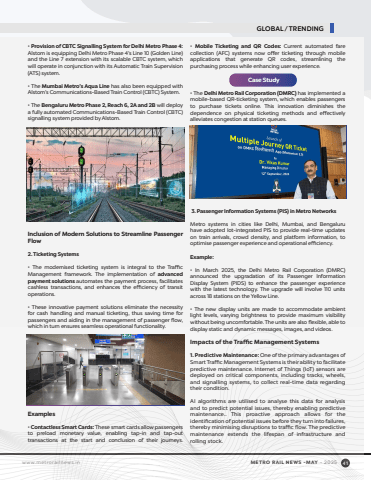
www.metrorailnews.in METRO RAIL NEWS -MAY - 2025 41%u2022Provision of CBTC Signalling System for Delhi Metro Phase 4:Alstom is equipping Delhi Metro Phase 4%u2019s Line 10 (Golden Line) and the Line 7 extension with its scalable CBTC system, which will operate in conjunction with its Automatic Train Supervision (ATS) system.%u2022 The Mumbai Metro%u2019s Aqua Line has also been equipped with Alstom%u2019s Communications-Based Train Control (CBTC) System. %u2022 The Bengaluru Metro Phase 2, Reach 6, 2A and 2B will deploy a fully automated Communications-Based Train Control (CBTC) signalling system provided by Alstom.Inclusion of Modern Solutions to Streamline Passenger Flow 2. Ticketing Systems%u2022 The modernised ticketing system is integral to the Traffic Management framework. The implementation of advanced payment solutions automates the payment process, facilitates cashless transactions, and enhances the efficiency of transit operations. %u2022 These innovative payment solutions eliminate the necessity for cash handling and manual ticketing, thus saving time for passengers and aiding in the management of passenger flow, which in turn ensures seamless operational functionality.Examples%u2022 Contactless Smart Cards: These smart cards allow passengers to preload monetary value, enabling tap-in and tap-out transactions at the start and conclusion of their journeys.%u2022Mobile Ticketing and QR Codes: Current automated fare collection (AFC) systems now offer ticketing through mobile applications that generate QR codes, streamlining the purchasing process while enhancing user experience.Case Study%u2022 The Delhi Metro Rail Corporation (DMRC) has implemented a mobile-based QR-ticketing system, which enables passengers to purchase tickets online. This innovation diminishes the dependence on physical ticketing methods and effectively alleviates congestion at station queues. 3. Passenger Information Systems (PIS) in Metro NetworksMetro systems in cities like Delhi, Mumbai, and Bengaluru have adopted Iot-integrated PIS to provide real-time updates on train arrivals, crowd density, and platform information, to optimise passenger experience and operational efficiency.Example:%u2022 In March 2025, the Delhi Metro Rail Corporation (DMRC) announced the upgradation of its Passenger Information Display System (PIDS) to enhance the passenger experience with the latest technology. The upgrade will involve 110 units across 18 stations on the Yellow Line. %u2022 The new display units are made to accommodate ambient light levels, varying brightness to provide maximum visibility without being uncomfortable. The units are also flexible, able to display static and dynamic messages, images, and videos.Impacts of the Traffic Management Systems1. Predictive Maintenance: One of the primary advantages of Smart Traffic Management Systems is their ability to facilitate predictive maintenance. Internet of Things (IoT) sensors are deployed on critical components, including tracks, wheels, and signalling systems, to collect real-time data regarding their condition.AI algorithms are utilised to analyse this data for analysis and to predict potential issues, thereby enabling predictive maintenance.. This proactive approach allows for the identification of potential issues before they turn into failures, thereby minimising disruptions to traffic flow. The predictive maintenance extends the lifespan of infrastructure and rolling stock.GLOBAL / TRENDING


