


Page 49 - Demo
P. 49
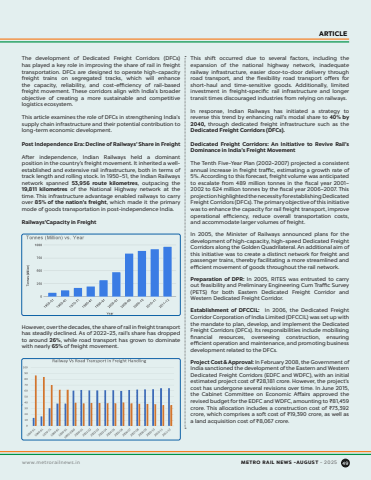
www.metrorailnews.in METRO RAIL NEWS -AUGUST - 2025 49The development of Dedicated Freight Corridors (DFCs) has played a key role in improving the share of rail in freight transportation. DFCs are designed to operate high-capacity freight trains on segregated tracks, which will enhance the capacity, reliability, and cost-efficiency of rail-based freight movement. These corridors align with India%u2019s broader objective of creating a more sustainable and competitive logistics ecosystem.This article examines the role of DFCs in strengthening India%u2019s supply chain infrastructure and their potential contribution to long-term economic development.Post Independence Era: Decline of Railways%u2019 Share in FreightAfter independence, Indian Railways held a dominant position in the country%u2019s freight movement. It inherited a wellestablished and extensive rail infrastructure, both in terms of track length and rolling stock. In 1950%u201351, the Indian Railways network spanned 53,956 route kilometres, outpacing the 19,811 kilometres of the National Highway network at the time. This infrastructure advantage enabled railways to carry over 85% of the nation%u2019s freight, which made it the primary mode of goods transportation in post-independence India.Railways%u2019Capacity in FreightHowever, over the decades, the share of rail in freight transport has steadily declined. As of 2022%u201323, rail%u2019s share has dropped to around 26%, while road transport has grown to dominate with nearly 65% of freight movement.This shift occurred due to several factors, including the expansion of the national highway network, inadequate railway infrastructure, easier door-to-door delivery through road transport, and the flexibility road transport offers for short-haul and time-sensitive goods. Additionally, limited investment in freight-specific rail infrastructure and longer transit times discouraged industries from relying on railways.In response, Indian Railways has initiated a strategy to reverse this trend by enhancing rail%u2019s modal share to 40% by 2040, through dedicated freight infrastructure such as the Dedicated Freight Corridors (DFCs).Dedicated Freight Corridors: An Initiative to Revive Rail%u2019s Dominance in India%u2019s Freight MovementThe Tenth Five-Year Plan (2002%u20132007) projected a consistent annual increase in freight traffic, estimating a growth rate of 5%. According to this forecast, freight volume was anticipated to escalate from 489 million tonnes in the fiscal year 2001%u20132002 to 624 million tonnes by the fiscal year 2006%u20132007. This projection highlighted the necessity for establishing Dedicated Freight Corridors (DFCs). The primary objective of this initiative was to enhance the capacity for rail freight transport, improve operational efficiency, reduce overall transportation costs, and accommodate larger volumes of freight.In 2005, the Minister of Railways announced plans for the development of high-capacity, high-speed Dedicated Freight Corridors along the Golden Quadrilateral. An additional aim of this initiative was to create a distinct network for freight and passenger trains, thereby facilitating a more streamlined and efficient movement of goods throughout the rail network.Preparation of DPR: In 2005, RITES was entrusted to carry out feasibility and Preliminary Engineering Cum Traffic Survey (PETS) for both Eastern Dedicated Freight Corridor and Western Dedicated Freight Corridor. Establishment of DFCCIL: In 2006, the Dedicated Freight Corridor Corporation of India Limited (DFCCIL) was set up with the mandate to plan, develop, and implement the Dedicated Freight Corridors (DFCs). Its responsibilities include mobilising financial resources, overseeing construction, ensuring efficient operation and maintenance, and promoting business development related to the DFCs.Project Cost & Approval: In February 2008, the Government of India sanctioned the development of the Eastern and Western Dedicated Freight Corridors (EDFC and WDFC), with an initial estimated project cost of %u20b928,181 crore. However, the project%u2019s cost has undergone several revisions over time. In June 2015, the Cabinet Committee on Economic Affairs approved the revised budget for the EDFC and WDFC, amounting to %u20b981,459 crore. This allocation includes a construction cost of %u20b973,392 crore, which comprises a soft cost of %u20b919,390 crore, as well as a land acquisition cost of %u20b98,067 crore. ARTICLE


