


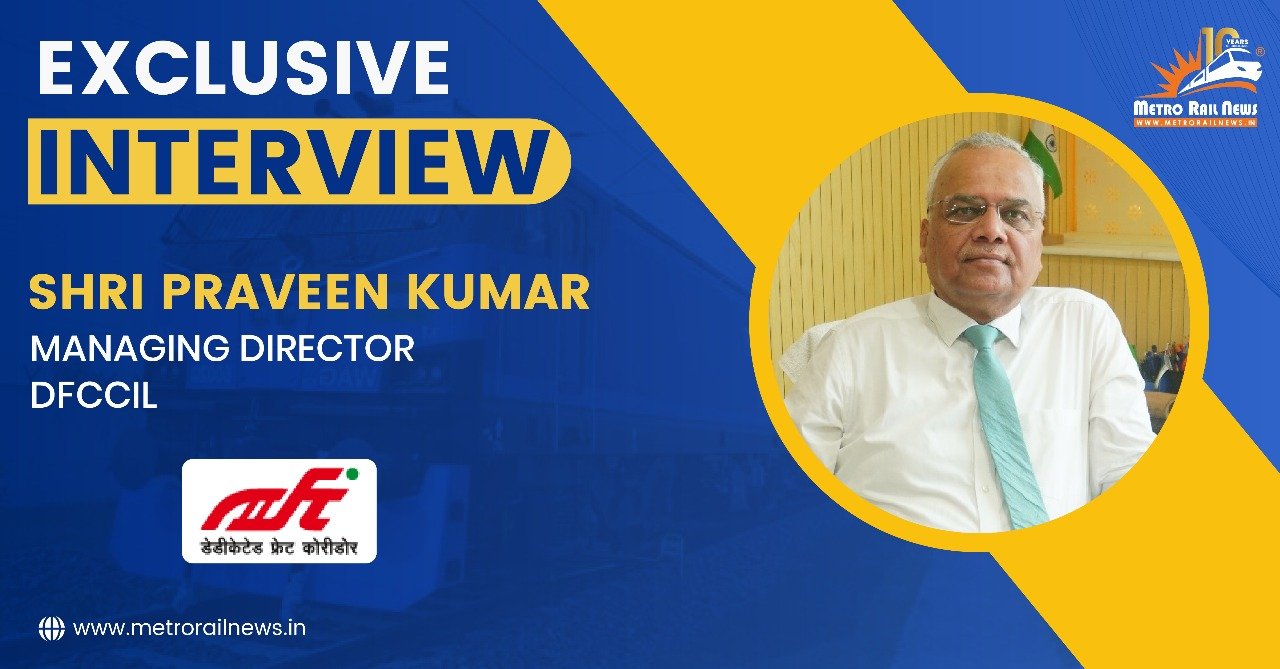
Metro Rail News conducted an exclusive interview with Shri Praveen Kumar, Managing Director, DFCCIL. In this discussion, Shri Kumar shared insights into the transformative role of Dedicated Freight Corridors (DFCs) in strengthening India’s logistics sector. He highlighted the operational performance of the corridors, their current freight-handling capacity, and the efficiency gains being achieved through dedicated infrastructure. Shri Kumar also elaborated on innovative initiatives such as “Trucks on Train,” which aim to decongest highways, reduce emissions, and enhance multimodal freight movement. This approach not only supports environmental sustainability but also contributes to improved utilisation of road infrastructure. Furthermore, he emphasised the potential of DFCs to reduce India’s logistics costs to below 10% of GDP, aligning with the national objective of building a more competitive and efficient freight ecosystem. Here are the edited excerpts:

1.You have been associated with the Dedicated Freight Corridors for over a decade. How would you describe the journey of DFCs from conceptualisation to the current stage? What are the milestones that DFCCIL has achieved under your leadership?
I have been associated with DFCCIL for over a decade. I have witnessed and contributed to the remarkable journey of Dedicated Freight Corridors (DFCs) from the visionary concept to the near completion of sophisticated freight infrastructure that is revolutionising India’s logistics landscape. The journey, marked by persistent efforts to overcome challenges related to land acquisition, complex project execution, and stringent procurement procedures, has been both demanding and rewarding.
While working for DFCCIL, I have crossed several critical milestones that underscore DFCCIL’s commitment and capability to deliver large-scale railway infrastructure projects. One of the hallmark achievements has been the commissioning of the Rewari-Dadri section, a strategic link that connects the Western and Eastern Dedicated Freight Corridors, effectively integrating these two major freight arteries into a cohesive national network.
In the past year, 37 Road Over Bridges (ROBs) were completed to ensure safe and smooth traffic flow along the corridors. A significant milestone was the breakthrough of the Kundevahal Tunnel, the last major segment of the JNPT-Vaitarna section, scheduled for completion by December 2025.
New Pirthala yard modification, the largest on the DFC network, featuring advanced interlocking and integration with key railway corridors, has set a new benchmark in freight yard modification. The Gati Shakti Cargo Terminal at Gothangam, operated by Emirates Logistics, marked a successful public-private partnership to boost freight handling. Another major step was the inauguration of the New Sanjali GCT in Gujarat, the first terminal built on private land under the Gati Shakti Policy. These developments highlight DFCCIL’s focus on expanding capacity, improving efficiency, and fostering innovation in freight logistics. Throughout my tenure, I have strived to ensure these projects not only meet but surpass safety, quality, and operational efficiency standards, recognising that the infrastructure we build today will drive India’s freight economy and industrial growth for generations. The journey of DFCs exemplifies a convergence of visionary planning, technical excellence, and meticulous execution, supported by a skilled, motivated workforce and robust stakeholder engagement.
2.You have extensive experience in railway infrastructure. What is your long-term vision for DFCCIL and its role in transforming freight movement in India?
As Managing Director of DFCCIL, with over three decades of extensive experience in railway infrastructure, my long-term vision for DFCCIL centers on transforming India’s freight transportation landscape into a world-class, efficient, and sustainable network that underpins the nation’s economic growth and global trade aspirations. Having been deeply involved in every phase of multiple mega railway infrastructure projects from conceptualization to commissioning, I understand the complex challenges and immense opportunities inherent in creating dedicated freight corridors of this scale.
I envision DFCCIL to be the pioneer in integrating cutting-edge technologies, advanced project management practices, and digital innovation to optimize operations and maintenance. Our corridors will incorporate multimodal connectivity, linking ports, industrial hubs, and consumption centers with seamless logistics solutions. This holistic infrastructure delivery will reduce logistics costs, improve supply chain reliability, and support the Make in India and Atmanirbhar Bharat initiatives.
3.Could you please reflect on the current freight carrying capacity of EDFC and WDFC, and what proportion of the nation’s railway freight movement do they currently handle?
Praveen Kumar: The Eastern Dedicated Freight Corridor (EDFC) and Western Dedicated Freight Corridor (WDFC) together span a total corridor length of 2,843 kilometers, of which 2,741 kilometers have been commissioned so far. The EDFC is fully commissioned, covering 1,337 kilometers from Ludhiana to Sonnagar, enabling seamless freight movement across this vital route. The WDFC has commissioned 1,506 kilometers from Dadri to Jawaharlal Nehru Port Trust (JNPT), with only about 102 kilometers remaining, which is scheduled for completion by December 2025.
Together, these corridors currently carry over 13% of the nation’s total railway freight while only accounting for about 4% of the total railway network. This disproportionate contribution demonstrates the immense capacity and efficiency gains achieved through the dedicated freight corridor model.
The operational performance of DFCs has also been robust. In August 2025 alone, 11,706 trains ran on the corridors, averaging 386 trains per day. From April 1 to August 31, 2025, the DFC network successfully operated 58,985 trains, demonstrating its reliability in handling high volumes of freight.
The performance metrics further reinforce this success. In August 2025, the corridors recorded a Gross Tonne Kilometre (GTKM) of 16,572 million tonne-km, while the cumulative GTKM from April to August stood at 82,950 million tonne-km. Similarly, the Net Tonne Kilometre (NTKM) performance reached 9,214 million tonne-km in August, with a cumulative 46,320 million tonne-km achieved over the five-month period.
4.How have the operational sections of the DFCs impacted freight efficiency, cost reduction, and reliability for Indian Railways so far?
The operational sections of the Dedicated Freight Corridors (DFCs) have significantly reduced logistics costs for Indian Railways and the overall economy. By providing dedicated, high-capacity, and high-speed freight routes, the DFCs have halved transit times in key corridors, allowing faster movement of goods and improved supply chain efficiency. This efficiency translates directly into lower freight charges and reduced overall logistics costs, a critical objective aligned with the National Logistics Policy’s goal to reduce logistics costs from 14-15% of GDP toward a sustainable target of below 10%.
The DFCs have also played a pivotal role in decongesting rail routes traditionally shared by freight and passenger trains. By shifting heavy freight movement to these specialized corridors, passenger train punctuality and reliability have improved significantly. The reduced congestion on existing lines further enhances Indian Railways’ overall operational efficiency.
In terms of reliability, the DFCs have enabled the provision of scheduled maintenance blocks in the Indian railway network by shifting freight traffic from Indian railway routes to these specialised freight corridors. These planned maintenance blocks ensure improved reliability of railway assets, enhancing safety in operations.
5.In terms of economic benefits, what measurable impact do you foresee DFCs will have on India’s logistics sector and industrial growth in the next 5–10 years?
The Dedicated Freight Corridors (DFCs) are set to bring profound and measurable economic benefits to India’s logistics sector and industrial growth over the next 5 to 10 years. By providing specialized, high-capacity freight routes that separate goods movement from passenger traffic, DFCs dramatically improve supply chain efficiency. This leads to significantly reduced transit times and freight costs, which are projected to lower commodity prices. Such cost savings enhance the competitiveness of Indian manufacturers and exporters, making Indian goods more attractive in global markets.
Furthermore, the corridors stimulate regional economic development, especially in previously underdeveloped areas. Integrated connectivity along the DFCs attracts investments in manufacturing clusters, logistics parks, and related industries, generating employment and fostering inclusive growth. The presence of state-of-the-art infrastructure like Gati Shakti Cargo Terminals ensures seamless multimodal transport solutions, reducing delays and enhancing cargo handling capabilities.
The DFCs also play a vital role in boosting India’s export-import capacity by connecting key port terminals more efficiently to the hinterland, thereby accelerating international trade flows.
6.What role will DFCs play in the government’s vision of reducing logistics costs to single digits as a percentage of GDP?
The Dedicated Freight Corridors (DFCs) are playing a pivotal role in achieving the government’s vision of reducing logistics costs to single digits as a percentage of GDP. Traditionally, India’s logistics costs have been around 14-15% of GDP, significantly higher than those of developed economies. DFCs will specifically help lower logistics costs to under 10% of GDP by creating a more efficient, reliable, and high-capacity freight transport ecosystem. By providing exclusive, high-speed freight routes separate from passenger traffic, DFCs drastically reduce transit times, fuel usage, and delays, directly cutting down transportation and inventory holding costs for businesses. The ability to run longer, heavier, and double-stack container trains means more goods can be moved per trip, significantly improving operational efficiency and cost-effectiveness.
DFCs also encourage a modal shift of freight from road to rail, which is not only cheaper but also reduces road congestion and wear-and-tear costs on highways. Integration with multimodal logistics parks and last-mile connectivity further streamlines cargo handling and reduces overheads. Electrification of the corridors enables energy-efficient train operations, which lowers fuel costs and emissions.
Additionally, the government initiatives like PM Gati Shakti and the National Logistics Policy complement DFCs by enhancing multimodal connectivity, enabling integrated logistics data platforms, and reducing procedural bottlenecks such as clearance delays and paperwork. Together, these efforts reduce wastage, improve supply chain transparency, and boost the competitiveness of Indian products.
7.How is DFCCIL integrating sustainability in its operations, particularly in terms of energy efficiency and emission reduction?
DFCCIL is deeply committed to integrating sustainability into every aspect of its operations, with a focus on energy efficiency and emission reduction as a core strategic priority. Central to this commitment is DFCCIL’s ambitious mission to achieve net-zero carbon emissions by 2030, aligning with India’s broader climate goals. This mission drives extensive efforts across corridor design, construction, and operations to minimise ecological footprints and advocate for railways as the most environmentally friendly freight transport mode.
Energy efficiency is being pursued through the complete electrification of the Dedicated Freight Corridors (DFC), which enables the use of electric traction that is far more efficient and cleaner compared to diesel alternatives. DFCCIL actively promotes renewable energy adoption, including solar power installations at its operation control centres at both corridors to offset energy consumption from conventional sources.
Emission reduction benefits are substantial, as DFCs enable a modal shift from road to rail, which is more energy-efficient and emits significantly fewer greenhouse gases per ton-kilometer of freight moved. By increasing freight volumes on electric corridors designed for high axle loads and double-stack containers, DFCCIL is reducing the number of trucks on roads, cutting congestion and vehicular emissions in urban and rural areas. For example, innovative service offerings such as the Trucks-on-Train (ToT) initiative on the Western Dedicated Freight Corridor (WDFC) are redefining sustainable freight transport. By shifting freight movement from road to rail, ToT significantly reduces carbon emissions—from 64 gms of CO₂ per Net Tonne Kilometre (NTKM) on road to just 28 gms on rail. Each ToT operation effectively removes nearly 45 trucks from highways, thereby alleviating road congestion and enhancing overall traffic safety. Beyond its environmental and decongestion benefits, the service also delivers substantial time savings, reducing transit duration from 24–26 hours by road to just 10–12 hours by rail.
Beyond infrastructure, DFCCIL embeds sustainability in corporate governance through rigorous environmental management systems, social responsibility engagement, and implementation of Global Reporting Initiative (GRI)-compliant sustainability practices. This includes community development, biodiversity conservation, waste management, and water stewardship along the corridors.
8. The 519 km Sonnagar–Dankuni stretch of EDFC is proposed to be developed under the PPP model. In this context, what opportunities do you see for public-private partnerships (PPPs) in the expansion and operation of DFCs?
The Sonnagar–Dankuni stretch of the Eastern Dedicated Freight Corridor (EDFC), spanning 519 kilometers, was initially proposed to be developed under the Public-Private Partnership (PPP) model. This approach aimed to leverage private sector participation for faster project delivery, innovation, and efficient operation. However, after careful consideration and evaluation of various factors, the decision has been made to shelve the PPP model for this particular stretch. The project’s development and operational responsibilities have now been shifted back under the direct purview of the Railway Board.
9. What are DFCCIL’s plans for increasing axle load capacity on the Dedicated Freight Corridors, and how will this upgrade impact freight efficiency and wagon design?
DFCCIL has increased axle load capacity on the Dedicated Freight Corridors from the initially designed 25 tonnes to 32.5 tonnes. This upgrade is a significant enhancement compared to the conventional Indian Railway network’s existing axle load of around 22.9 tonnes. The infrastructure, including track, bridges, and formation, has been constructed and strengthened to support these heavier loads at higher speeds, enabling the running of long, heavy trains efficiently.
The increase to 32.5-tonne axle loads will dramatically improve freight efficiency by allowing each wagon to carry substantially heavier loads, which reduces the number of trains required to move the same volume of cargo. Longer trains, some up to 1,500 meters in length, combined with higher axle loads, will increase throughput manifold on the corridors, accelerating goods movement and reducing congestion on other rail routes.
Wagon design will correspondingly evolve to accommodate these heavier loads, leading to more robust and durable rolling stock capable of sustaining higher stresses while maintaining safety and reliability. This demands innovations in materials, suspension systems, and braking technologies to ensure the upgraded wagons perform optimally at increased axle loads.
Ultimately, the axle load enhancement represents a leap toward world-class heavy haul freight rail operation, offering India a competitive edge through cost-effective, high-capacity, and rapid freight transportation, which supports the country’s expanding industrial and economic growth needs.
10.Beyond the Western and Eastern corridors, what is the current status of the new proposed DFCs?
Beyond the fully operational Eastern Dedicated Freight Corridor (EDFC) and the nearly completed Western Dedicated Freight Corridor (WDFC), with just 102 km of its length pending completion by December 2025, several new Dedicated Freight Corridors are in the planning and development stage. The Ministry of Railways has undertaken detailed project reports (DPRs) for three new corridors: the East-Coast Corridor (Kharagpur to Vijayawada), the East-West Corridor (Palghar-Bhusawal-Nagpur-Kharagpur-Dankuni and Rajkharsawan-Kalipahari-Andal), and the North-South Sub-corridor (Vijayawada-Nagpur-Itarsi). These DPRs are currently under examination, and these corridors are yet to receive formal sanction.
While the Eastern and Western corridors handle the bulk of current freight volumes and operational traffic—more than 400 trains running daily—the introduction of new corridors will alleviate pressure on existing routes, and drive sustained growth in rail-based logistics in the coming years.
11.How do you see the role of global funding agencies like JICA and the World Bank in the success of DFC projects?
Global funding agencies like the Japan International Cooperation Agency (JICA) and the World Bank have played a crucial role in the success of Dedicated Freight Corridor (DFC) projects in India. Their financial support has been instrumental in facilitating the construction and modernization of these high-capacity freight networks. JICA has been the primary financier for the Western Dedicated Freight Corridor (WDFC), providing concessional loans that have enabled the development of critical infrastructure spanning from Delhi to Mumbai.
Similarly, the World Bank has been a key partner in financing the Eastern Dedicated Freight Corridor (EDFC), supporting multiple phases of its development. Their involvement encompasses not just funding but also technical expertise, capacity building, and implementation oversight. The World Bank’s financial packages have helped expand India’s freight capacity while ensuring adherence to global best practices in environmental and social standards.
Beyond funding, both agencies contribute to strengthening institutional capacity within DFCCIL by promoting transparency, project management excellence, and sustainability frameworks. Their support aligns with India’s goals of fostering regional economic development, reducing greenhouse gas emissions through cleaner rail transport, and enhancing freight logistics efficiency.
12. What message would you like to convey to the readers of Metro Rail News?
I would like to emphasize the transformative impact that Dedicated Freight Corridors (DFCs) are having on India’s freight logistics sector. DFCs have significantly increased the contribution of rail freight to the country’s overall logistics ecosystem by enabling faster, safer, and more efficient transportation of goods. Innovative services like “Trucks on Train” offer seamless integration between road and rail, allowing cargo to move efficiently over long distances while retaining the flexibility of last-mile trucking. High-speed small cargo services complement freight operations, catering to time-sensitive shipments.
The introduction of double-stack container trains on the Western Dedicated Freight Corridor (WDFC) has dramatically boosted container handling capacity, while the Eastern DFC’s design accommodates heavy-haul trains with higher axle loads, enabling the transport of larger volumes with fewer trips.
DFCs act as catalysts for building integrated, multimodal logistics networks that connect industrial hubs, ports, and cargo terminals seamlessly. This integration not only optimises freight movement but also improves supply chain reliability and transparency. Ultimately, the growth of the DFC network is positioning India’s freight logistics sector to meet future economic demands with world-class infrastructure, contributing significantly to national GDP growth, regional development, and environmental sustainability.